Have you just watched Maverick (1994)?
Or are you trying to learn five-card draw poker out of curiosity?
Either way, you have come to the right place.
The classic form of Poker is Five-card draw, and we all have grown up watching Hollywood movies that feature this game, and Maverick is its most popular example. In fact, calling five-card draw the foundation of modern poker variants isn’t an exaggeration.
In fact, before Texas Hold’em started gaining popularity, it was a five-card draw poker game that was players’ first choice. Many directors used this game to create psychological tension and arouse viewers’ interest in the screenplays of movies that were made around poker. Now let’s come out of the screen and learn how to play five-card draw poker. In this guide, you will not just learn about the rules of the game but will also learn to read your opponents.
Let’s Understand the Basics
In a five-card poker game, the main target is to create a stack of the five strongest cards after exchanging cards(one time) or by betting enough chips that could convince other players to quit the game before it ends.
Let’s see the strongest to weakest cards according to the five-card draw poker game rules:
- If you have A, K, J, Q, and 10 from the same suit, it is called a royal flush and is considered the strongest hand in the game.
- If you manage to get five cards in a sequence belonging to the same suit, it is considered the second strongest combination; it is called a straight flush.
- When you have four cards of the same rank, they are called Four of a Kind and are again a great hand to have.
- Another stronger option is having three cards of the same rank along with a pair of another rank.
- If you have five cards of the same suit, it is a combination of moderate strength and is called a flush.
- You can also collect five cards in a sequence to create a stack of moderate strength.
- Now, this is a combination of moderate to low strength where you have three cards of the same rank.
- Another low-rank combination is having two different sets of pairs of cards.
- This is the second-lowest combination where you have one pair, i.e., two of a kind.
- You are at the lowest rank when you don’t have any pair; this situation is called a high card.
How to Play Five Card Draw Poker?
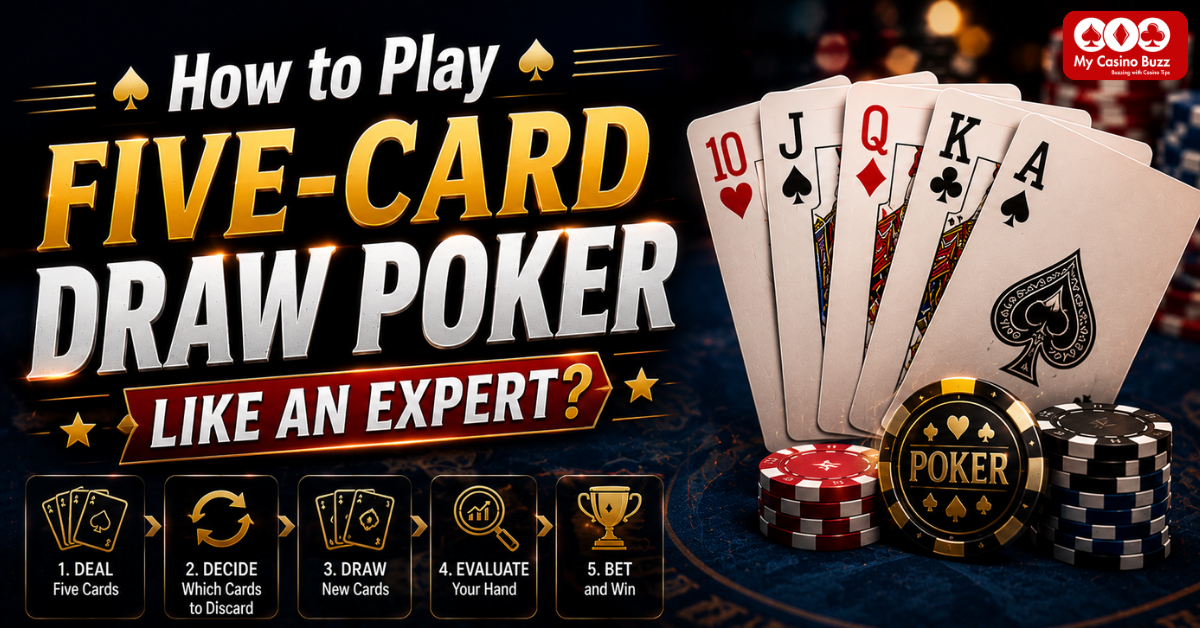
You must have understood the rules; the next step is to learn how to play five-card draw online:
- When you play the game in a real casino, you have to place a bet in the pot before drawing cards, but in the online setup, the system will take the bet automatically and will show five cards on the screen.
- In Virtual setup, you don’t have to count the number of chips. Your only task is to click on buttons for the next action. It could be a call, fold, or raise.
- In the next step, all you need to do is click on the cards that you want to discard, and the system will replace them with another card.
- In the end, you don’t have to count the chip amounts manually; the computer will do the math and will declare the winner with the best five cards and reward him instantly.
Strategies to Win Five Card Draw Poker

As a beginner, you should consider these tips while playing five-card draw poker online:
- It is advisable to start with good cards like Jacks, Queens, or four cards to a straight or flush. The moment you find weak hands, fold them away even before spending a penny.
- You can estimate the strength of other players’ stacks by counting the number of cards they are discarding. For example, if they are discarding 3 cards, that means they have two good cards and are trying to improve by throwing three useless cards. Also, if somebody does not swap any cards,d that means they already have a strong stack or all five cards are weak and are pretending to have a great stack only to scare you so that you can quit even before the game ends.
- It is advantageous to act last in the betting round as it allows you to see how many cards others discarded before you make your move.
- Also, you should be careful with bluffing. Often, players click on “call” only to make bigger moves in the end.
Ending Words
If you are playing this game for the first time, it is strongly recommended that you start your journey with free online options. It will help you understand the complexities of the game without getting intimidated by the pressure of live players and noise. And once you get the knack, you can start betting with small amounts. Five-card draw poker is an interesting game, but you should not fall into the trap of an adrenaline rush and play responsibly.